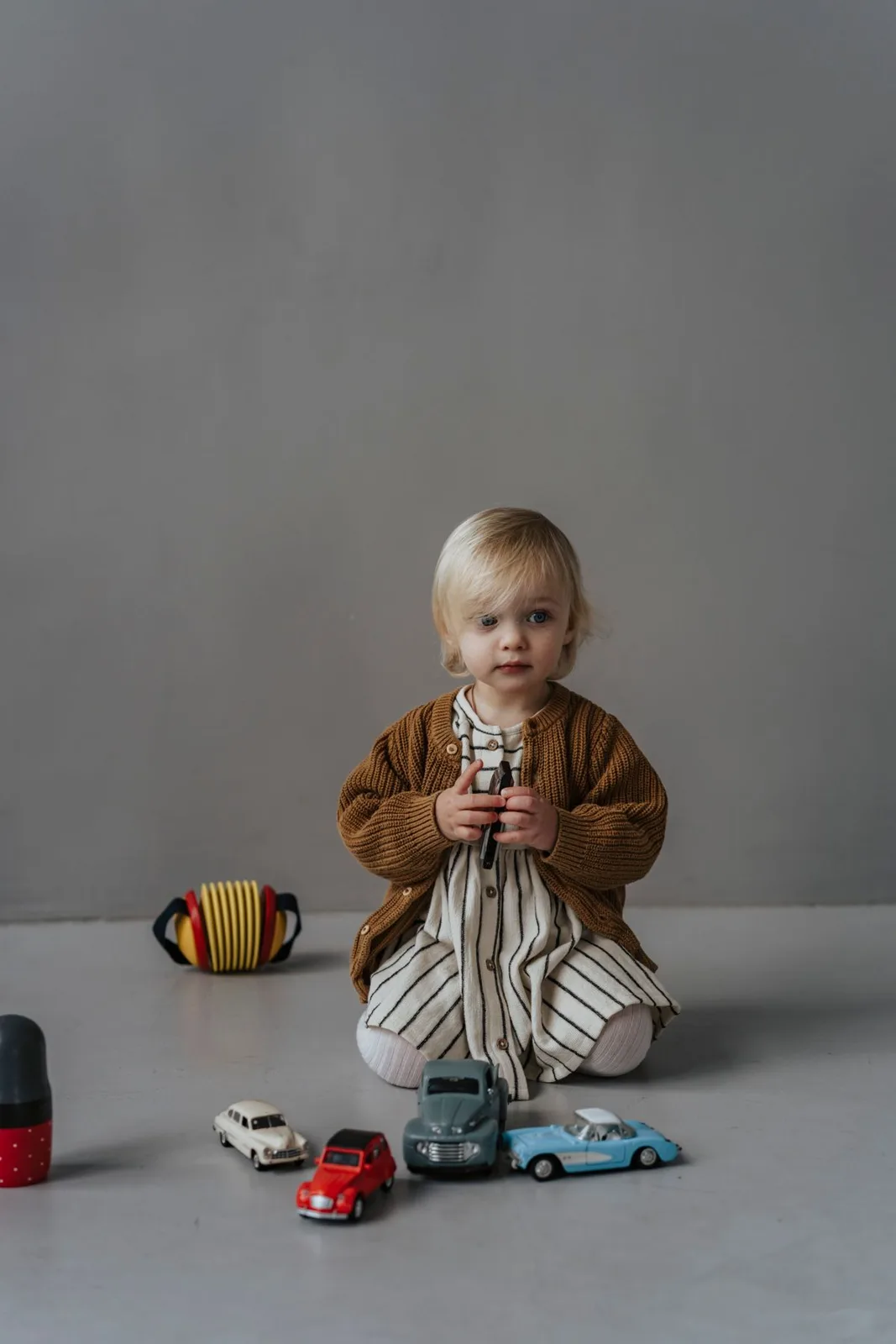
A toy-car road does not need to circle the furniture. A compact route with a few useful destinations can provide more play than a long track that blocks the room. Start with a loop, a parking place and one stop that children can invent a story around.
Choose toy vehicles appropriate for everyone who can reach them. Keep the road clear of doors and the main route through the room.
Measure with the car, not a ruler
Lay a favourite vehicle on a piece of plain card and leave space on both sides. That gives you a practical road width. Cut or tear broad strips with adult help, then try a curve before making a whole set.
Card sections can rest on a rug or suitable flat surface without adhesive. If you prefer tape, check that it is appropriate for the surface and remove a test piece before marking a larger area. Do not assume every floor covering tolerates it.
A board or large tray can hold the route if the room must be cleared quickly. Keep it small enough for an adult to move steadily without pieces sliding off.
Add places with different jobs
Use a small box as a garage and a folded paper sign as a delivery stop. A drawn rectangle can be a car park. Leave the buildings separate from the road so children can change destinations without rebuilding everything.
Try one practical problem: a parcel needs collecting, the bus has three stops or a vehicle needs somewhere to turn. These give the road a purpose without requiring a collection of new accessories.
For a child who prefers arranging, making parking rows may be the main activity. Another may want to narrate a long journey. Both can use the same compact layout if there is enough room to reach their part.
Build in ways to pass and share
A narrow road can create constant collisions when siblings play. Add a wider passing place or two short parking bays where a vehicle can wait. Let children test whether their largest vehicle fits the bend before fixing its shape.
Agree what happens when two cars meet. They can take turns, reverse to a passing place or use an imaginary one-way sign. The rule should help play move along, not make one child the traffic police for the whole session.
Offer a route for different ages
Older children might draw a simple map or design route cards. Younger children can follow a coloured line to the matching destination. Keep written labels optional.
Pack the route in sections
Before stopping, ask which destination the vehicles need to reach for the night. Parking them supplies a clear final action. Then collect signs and road strips together in a flat envelope or shallow box.
Return cars to their usual storage and remove any temporary floor markings. If children want to rebuild the same route, photograph it first. A road that fits its room can be offered again without needing to reclaim the entire house.
Make it work for your family. Keep the useful bits and change the rest.