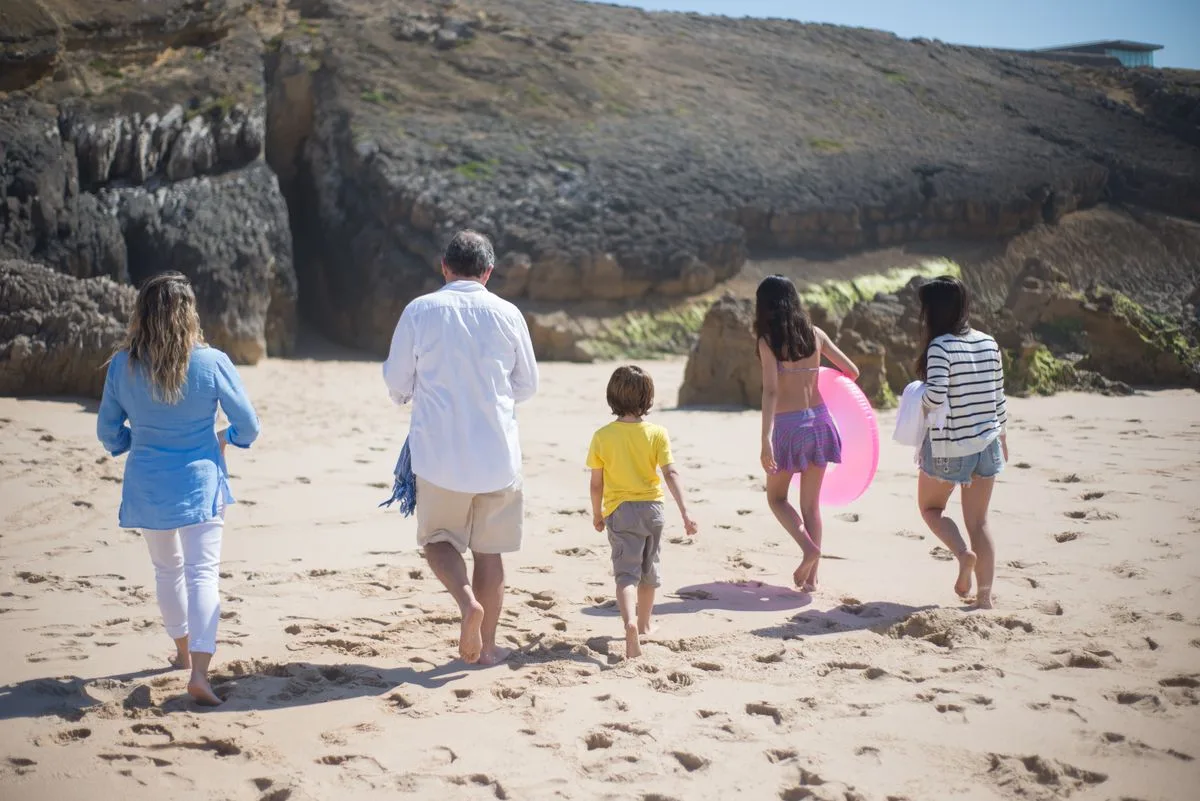
The halfway point of a family walk is often reached before anybody feels halfway tired. At the coast, the return also depends on weather, tides and the route itself. Choose a conservative turning point before setting off, rather than deciding only when someone has had enough.
Pick an established route suited to the whole group. A promenade or an inland path with coastal views may be a more manageable choice than an exposed cliff-top trail.
Check the route and current conditions
Use the land manager's information to check closures, surfaces, gradients, barriers and access. Look at the forecast and local warnings. If any part involves a beach or tidal crossing, understand tide times and the possibility of the route being cut off.
The RNLI's coastal walking advice recommends checking weather and tides, keeping away from waterside edges, telling someone your route and return time, and carrying a means of calling for help. Apply those precautions to a short outing too.
Avoid a route that depends on children keeping perfectly to a narrow edge. Stay away from unstable cliffs and follow local signs. Do not go down to the foot of cliffs for shelter or a photograph.
Set a landmark and a latest time
Choose a turning landmark well within the distance the least confident walker can manage. Also choose the latest time to turn, allowing for a slower return. Use whichever comes first.
Explain the plan plainly: “We are going as far as the second sheltered bench, unless we need to turn sooner.” Do not describe a distant lighthouse as the goal if reaching it is unlikely.
Build in a place to pause on the suitable route. Keep the food and drink plan practical, including safe storage and any facilities the family needs.
Keep looking separate from moving
When a view catches everyone's attention, stop in an appropriate place away from hazards. Children can look for patterns in the water or describe the shape of the coastline without approaching an edge.
An older child may help identify landmarks from a map, while a younger one looks for a familiar colour. Adults remain responsible for navigation and supervision. Wind can make spoken instructions hard to hear, so keep the group close enough to communicate clearly.
Turn earlier when the plan needs it
Changing weather, slippery ground or a child's discomfort is enough reason to shorten the walk. The planned landmark is a maximum, not a target that must be reached.
If anyone is in danger at the coast, call 999 or 112 and ask for the Coastguard. Give the clearest location information you have.
On the return, recognise familiar landmarks and keep enough attention for the ground underfoot. Afterwards, note what made the route suitable or unsuitable for your family. Check conditions afresh on another day; an enjoyable previous walk does not guarantee the same circumstances next time.
Make it work for your family. Keep the useful bits and change the rest.